

If you’re wondering about what is the child tax credit for 2026, you’re not alone. A lot of parents and guardians want to know how the new changes in tax laws will affect the finances of their families. The Child Tax Credit (CTC) has undergone a few changes, and the 2026 rules contain some critical adjustments about your eligibility, the amount you can claim, and what you need to file.
Table of Contents:
- What’s the Child Tax Credit for 2026?
- Why the Child Tax Credit Is Important
- How Much Will the Child Tax Credit Be in 2026?
- Who Qualifies for the 2026 Child Tax Credit?
- Income Caps and Rules for Phasing Out
- Qualifying Child Criteria
- Amount of the Credit Refundable
- Major Child Tax Credit Changes Coming in 2026
- Claiming the Child Tax Credit
- Things Not To Do
- How the Child Tax Credit Helps Families
- Tax Season Planning
- Frequently Asked Questions
- Conclusion
- Know Your Tax Rights? Need Help? Call the Tess House Law Firm Today.
What’s the Child Tax Credit for 2026?
What is the child tax credit for 2026 will be based on the current federal tax rules and the annual inflation adjustments from the IRS. The Child Tax Credit (CTC) provides assistance to families with qualifying children by reducing the amount of federal income taxes owed. For many, it’s one of the most valuable tax credits because it directly decreases your tax payment and, in some situations, can lead to a refund.
If you match the IRS’s standards for income, filing status, dependency, domicile, and your child’s age and citizenship, you may be able to claim up to $2,200 for each qualifying child in 2026. The credit has been increased with inflation, although not everyone will get the whole amount. How much you get depends on your income, how many qualified children you have, and if your credit is lowered because your income is above specified restrictions.
The Child Tax Credit was intended to offset the cost of raising children. Families today are spending more than ever on housing, childcare, healthcare, education, food, clothing, transportation and other everyday requirements. The credit reduces your taxes so you can keep more of your money to help your children’s well-being and future.
The Child Tax Credit is especially useful because it’s a credit and not a deduction. Reduce your taxes, but they do it differently. A deduction reduces your taxable income and could reduce the tax you pay, depending on your tax rate. A credit, however, will reduce your tax bill directly. So if you qualify for a $2,200 Child Tax Credit, your tax payment is reduced by $2,200, which is better than a deduction for the same amount.
A crucial component of the Child Tax Credit is that portion of it is refundable through the Additional Child Tax Credit (ACTC). This means if your tax payment is less than the credit, you could still get some of the extra amount back as a refund, providing you follow IRS standards. For many working families with low and moderate incomes this return can be a huge boost.
So it’s good to know that the child tax credit for 2026 isn’t automatic. You must satisfy IRS regulations about your child’s age, relationship to you, residency, dependency, Social Security number and your income. If you earn more, you could be able to claim less as your income goes up.
Over the last decade, the Child Tax Credit has been subject to many legislative revisions as Congress has sought to adapt to changing economic conditions and provide support to working families. The COVID-19 outbreak led to temporary expansions that considerably enhanced the credit and made it completely refundable for many taxpayers. Those temporary measures have now expired and the 2026 credit follows existing regulations under more recent tax legislation, including annual inflation adjustments that increased the maximum credit to $2,200 per qualified child.
“The Child Tax Credit remains an essential part of the tax code, helping millions of families lower their tax bills, improve their finances, and manage the rising costs of raising children.” If you’re a new parent, or just want to check to see if you qualify, knowing the 2026 rules will help you claim every tax advantage you deserve and avoid mistakes that could delay or lower your return.
Why the Child Tax Credit is Important?
It’s quite expensive to raise children. Families are responsible for the cost of:
- Housing Food Clothes
- Child care Health care Education Transportation
- Activities off-campus
The Child Tax Credit was intended to help ease the financial burden and make having children more affordable.
For many families, the credit can:
- Less axes due
- Boost tax refunds
- Boost the cashflow of your household.
- Lower stress on finances
- Support family stability in the long term.
Before you file your tax return, you should understand what the child tax credit for 2026 is, because it affects your finances.
How Much Will the Child Tax Credit Be in 2026?
The question most asked of taxpayers is:
“What is the 2026 Child Tax Credit?”
Currently, under federal law, the maximum Child Tax Credit for the 2026 tax year is up to $2,200 for each qualified child.
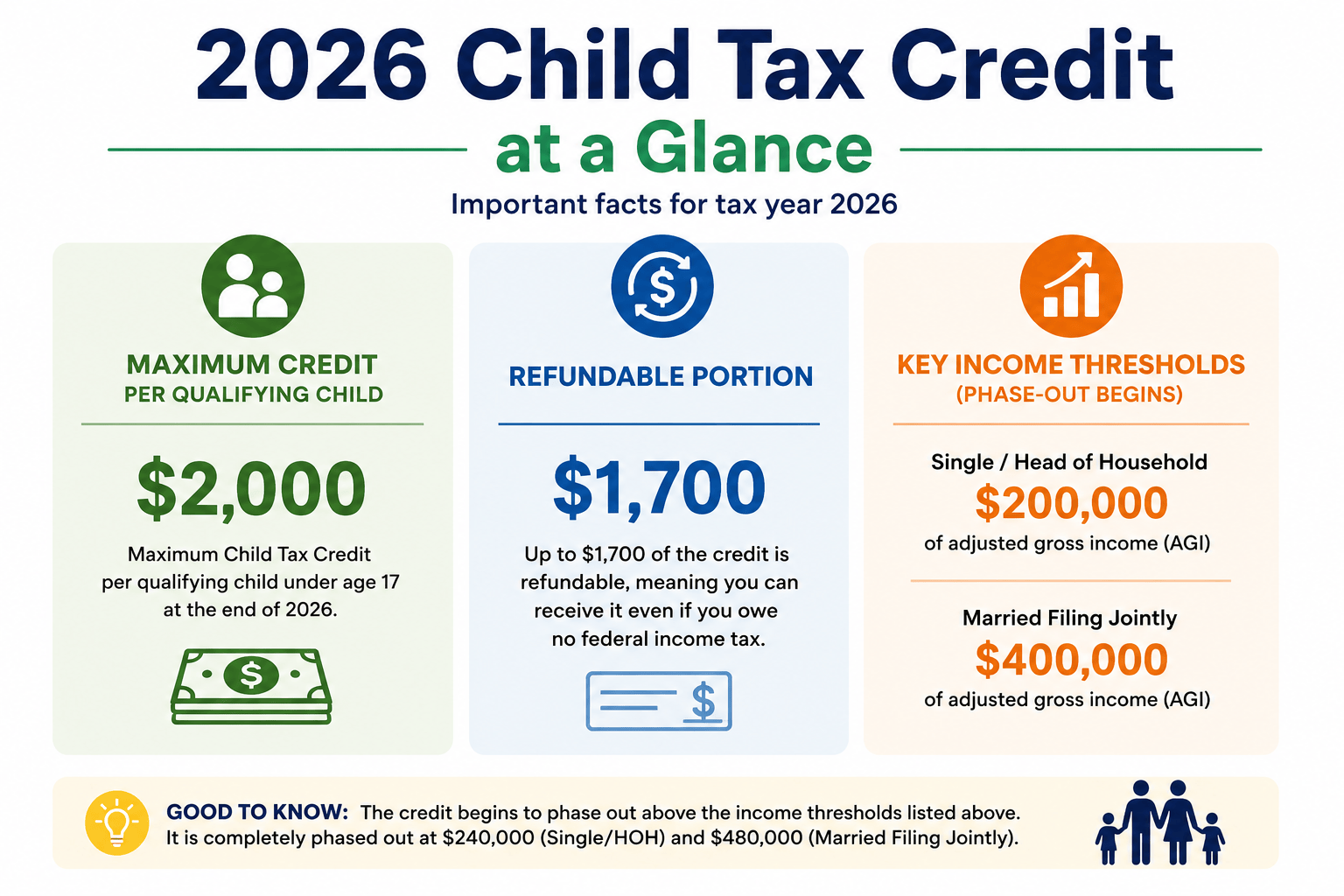
Exactly how much you get depends on a few factors including:
- Income of the household
- Tax obligation
- Number of eligible children
- Refundable percentage of credit eligibility
Some taxpayers will qualify for the full amount, and families with higher incomes may have the credit reduced due to income phase-out restrictions.
Who Qualifies for the 2026 Child Tax Credit?
Not every youngster is eligible for the credit. Generally, the child must be eligible for the Child Tax Credit for 2026 if:
Maximum Age Should Be 16
The youngster must be under age 17 at the conclusion of the tax year.
Your Qualifying Child
Usually, the child must be your:
- Son of God
- Daughter
- Stepchild
- Foster child placed with an approved agency
- Brother Sister
- Half-brother or half-sister
- Step sister/brother
- grandson
- Niece
- Nephew
- Some of the children of these relatives.
Live With You (Live)
In most cases, the child must have lived with you more than half the year.

Short-term absences for:
- Education
- Medical treatment
- Service in the military
- Vacations
generally do not affect residency.
Claim as a Dependent
The youngster must be listed as a dependent on your federal tax return.
U.S. Citizen, U.S. National or U.S. Resident Alien
The child must meet citizenship or residency criteria and, usually, the youngster must have a valid Social Security number for employment.
Income Caps and Rules for Phasing Out
Most taxpayers will be able to claim the entire credit, but high-income households could see a reduction in their Child Tax Credit.
In general, the credit begins to taper down when modified adjusted gross income (MAGI) exceeds:
- $200,000 for single, head of household and married filing separately filers
- $400,000 for those filing as Married Filing Jointly
If you earn more than this, the credit is gradually phased out until it is eliminated.
Knowing what your expected income is before you file will help you predict how much of the credit you might get.
Qualifying Child Criteria
In addition to age and residency, a qualified kid must generally:
- more than half the year with you lived.
- Not providing more than half of their own financial support .
- Be younger than you (unless handicapped permanently)
- Possess a valid social security number.
- Meet IRS standards for relationships and dependencies.
These standards ensure that the credit is received by taxpayers who are mostly responsible for sustaining the child.
Amount of the Credit Refundable
One key element of the Child Tax Credit is that a portion of it might be refundable through the Additional Child Tax Credit (ACTC).
This implies that if the credit is more than the amount of federal income tax you owe, you may still receive a refund of some of the remaining credit if you fulfill the eligibility requirements.
The amount that can be refunded is limited by law and by how much you made. Families with lesser tax burden may check the requirements for the ACTC or speak with a tax advisor to determine how much they may get.
Major Child Tax Credit Changes Coming in 2026
Tax laws do change, and there have been some legislative changes to the Child Tax Credit in recent years. Factors that will play a role in the 2026 tax year are:
Maximum Credit Raised
The credit ceiling was increased to $2,200 per eligible child to account for an inflation adjustment.
Adjustments for Inflation
Some tax provisions are indexed for inflation each year, which helps preserve the value of the credit over time.
Further rules for refundability
Eligible taxpayers who fulfill the applicable earned income and refundability conditions may still claim the Additional Child Tax Credit .
For the kid Tax Credit, a kid normally must have a valid Social Security number issued by the due date of the tax return (including extensions).
Tax rules can change with new legislation, so families should check the latest before they file their 2026 filings.
Claiming the Child Tax Credit
If you match the eligibility requirements, claiming the Child Tax Credit is rather easy.
Step 1: Collect Documents
Prepare:
- Social Security numbers
- Birth Certificates (if required)
- Income verification
- Tax returns
- Dependency data
Step 2: Prepare Your Tax Return
File:
Finally, if necessary, fill out Schedule 8812 to calculate the Child Tax Credit and Additional Child Tax Credit.
Step 3: Eligibility Check
Check twice:
- Revenues
- Filing Status Residency Dependents Age Requirements
Step 4: File using Electronic Means
E-filing minimizes errors and usually results in speedier processing and refunds.
Things Not To Do
Many people accidentally lower or lose their Child Tax Credit by making mistakes that can be avoided.
Claiming a Child That Is Not Eligible
Always check rules for age, residency, relationship and reliance.
Wrong information can slow down processing or cause the credit to be denied.
Filed with status Incorrect
Incorrect filing status may influence your eligibility or the amount of your credit.
Schedule 8812: Forgets
Some taxpayers don’t fill out the relevant papers, which causes delays in refunds or leads to calculation problems.
Not Keeping Records.
Keep documents to support:
- Residence Custody Income Dependence Childcare records if necessary
- Good record-keeping can be useful if the IRS requires extra information.
How the Child Tax Credit Helps Families?
The Child Tax Credit is not just a tax break. And it can assist your family’s finances too.
Families usually use the savings for:
- Pay your rent or mortgage.
- Groceries shopping
- Subsidize childcare expenses
- Pay health care expenses
- Save for practice
- Build an emergency reserve
- Eliminate debt
This credit is significant financial support to many families when it comes time to submit their taxes.
Tax Season Planning
If you are prepared in advance, you can best utilize the tax benefits.
Consider these steps:
Look at Your Earnings
Estimate your income for the year to get a sense of whether the credit might be phased away.
Maintain Key Records
Arrange:
- W-2s
- 1099s
- Social Security number card
- School record
- Custody arrangements (if applicable)
Change Your Personal Details
Notify IRS and Social Security Administration if you alter your name or address and it could effect your return.
Talk to a Tax Expert

Tax complexity might increase with divorce, shared parenting, self-employment or multiple dependents. A tax professional can help ensure you’re claiming every credit you’re entitled to.
Frequently Asked Questions
1. What is the 2026 Child Tax Credit?
The 2026 Child Tax Credit is worth up to $2,200 per qualifying child, depending on income limitations, eligibility conditions and IRS standards.
2. Who can claim the Child Tax Credit in 2026?
A eligible child must generally:
- Be at most 17 years old at the end of 2026
- be your qualified child
- Lived with you more than half a year
- Be a citizen, national or resident alien of the U.S.
- Must possess a valid Social Security number.
You also must meet the applicable income and filing criteria.
3. Am I eligible for a Child Tax Credit refund?
Yes. The Additional Child Tax Credit (ACTC) is a refundable credit for some eligible taxpayers and may offer a refund even if the taxpayer owes little or no federal income tax, subject to statutory restrictions.
4. What salary is too high to get the full Child Tax Credit?
The credit often begins to phase down when modified adjusted gross income is more than:
- $200,000 for most individual filers.
- $400,000 married couples filing jointly
Credit is diminished progressively at certain thresholds.
5. Can a divorced/separated parent claim the same child?
No. The kid Tax Credit can generally only be claimed for a qualified kid by one taxpayer for any one tax year. Only one of you can claim the child as a dependent, and the IRS tie-breaker regulations and custody agreements will establish who that is.
Conclusion
Knowing the child tax credit for 2026 will help you optimize your savings and avoid mistakes. The child Tax Credit remains one of the best tax benefits for parents, with a maximum credit of $2,200 per child. But there are new eligibility restrictions, income limits and refund options.
Tax laws are complicated, and every family is different. See current IRS instructions. Keep your records up-to-date. If you have questions, ask a professional. It’s a clever idea. If you’re claiming this credit for the first time, or if you’ve claimed it before, knowing the rules can help you get the full tax benefit you’re entitled to.
Know your tax rights? Need help? Call the Tess House Law Firm today.
Tax rules and finances can be highly confusing, especially if you are going through family upheavals, IRS issues, audits or legal concerns. At Tess House Law Firm, we can help you sort through these issues with confidence.

If you have questions about the Child Tax Credit, need help resolving an IRS issue, or need competent legal representation in tax or financial matters, our knowledgeable staff is ready to help. We hear your individual story and offer practical guidance designed to safeguard your legal rights and your financial well-being.
Don’t bet the farm on your biggest tax decisions. Contact Tess House Law today to schedule a consultation and learn how our skilled legal team can help you move forward with confidence and peace of mind.