

Divorce is seldom simple. There is also the emotional toll and critical legal decisions that affect the couple’s finances, children, property and future. One of the first major decisions is whether to go to litigation or mediation. Each option has its pros and cons, depending on your situation, your style of communication and what you want to accomplish.
Divorcees who want to settle things amicably want to be in control of the outcome. Certain ones need a judge due to too much conflict, abuse, or other disagreements that can’t be solved discreetly. Knowing the difference between litigation and mediation will help you choose the best path to protect your rights and the future of your family.
Table of Contents:
- Divorce Mediation: What Is It?
- Divorce Litigation Defined
- Litigation vs Mediation: Know the Main Differences
- When Is Litigation the Better Option?
- When Should You Litigate?
- When Is Mediation the Better Option?
- When Is Litigation Needed?
- Cost Comparison
- Confidentiality and Privacy
- Child Custody Issues
- Emotional Impact on Families
- Is It Possible to Combine Litigation and Mediation?
- Mediation vs Litigation: How to Decide
- Frequently Asked Questions
- Conclusion
- Contact Tess House Law Firm Today
Divorce Mediation: What Is It?
Divorce mediation is the process in which both spouses voluntarily negotiate the terms of the divorce with the assistance of a neutral third party mediator.
The mediator represents neither spouse, nor does he or she make legal judgments. Instead, they help facilitate productive discussions and encourage both parties to identify terms that work for them.

Typical topics include:
- Division of property
- Allocation of Debt
- Child custody
- Schedules for parenting
- Children support
- Alimony
- Future correspondence
Attorneys can prepare the legal paperwork to be filed with the court for approval if settlements are achieved.
Mediation is about working together, not fighting each other.
Divorce Litigation Defined
Litigation is the usual court process, when each couple hires a counsel to advocate on their side.
If couples are unable to reach agreement, the court will decide the matters in dispute after considering the evidence and hearing witnesses.
The litigation procedure usually includes:
- Submission of legal pleadings
- Invention
- Depositions
- Hearings in the interim
- Movements
- Settlement conferences
- Tried by a judge
Litigation is governed by strict legal procedures and time limits, which makes it more formal and more adversarial.
Litigation vs Mediation: Know the Main Differences
When comparing litigation vs mediation, several important factors come into play.
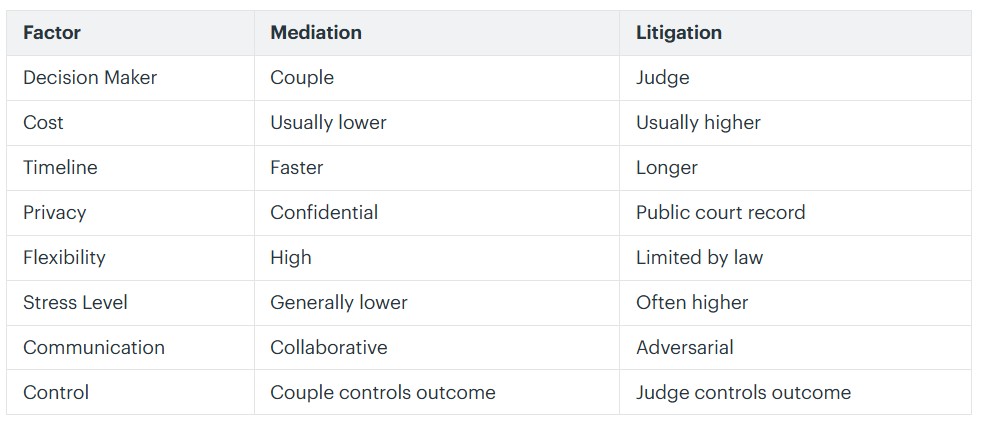
Understanding these distinctions helps determine which option aligns with your goals.
When is Litigation the Better Option?
Many couples opt for mediation because it encourages healthy communication and provides more freedom.
Key benefits include:
Lowered costs
Court litigation can be costly because of:
- attorneys fees
- Costs of court
- Witnesses with expertise
- Testifying
- Additional hearings
Mediation usually takes less billable time.
Speedy Resolution
A mediated divorce might be completed in just a few weeks or months. Divorces that go to court can take anywhere from 6 months to several years depending on court scheduling and intricacy.
Increased Privacy
Mediation meetings are confidential unlike judicial procedures. Money, parenthood and personal issues are often sensitive and hence are usually kept secret.
Better Child-Parent Relationships
Couples who work through arguments together frequently build improved communication patterns that benefit their children after divorce.
Tailored Solutions
Mediation gives spouses the ability to design innovative agreements that are tailored to their family’s circumstances, rather than being subject to generic court rulings.
When Should You Litigate?
Mediation is effective for many families, but there are cases when litigation is necessary.
Benefits include:
Protection by court
Where one spouse refuses to cooperate, orders can be made enforceable by the court.
Powers of Discovery
Through legal discovery, lawyers might get hold of financial records.
This is especially useful if one partner is concealing:
- Earnings
- Asset Management
- Retirement savings
- Business Property
Disaster Relief
Courts can issue quickly:
- Protective orders
- Provisional custody orders
- Financial limitations
- Emergency Assistance
Legal Power
If the spouses cannot come to an agreement after trying to work out a deal, then a court can make decisions that are binding on the spouses and resolve the dispute.
When is mediation the better option?
Mediation is usually most effective when:
* Spouses communicate respectfully.
* Neither spouse is afraid of the other.
* Transparency of financial information. They both want to avoid a fight if they can.
* Child’s welfare above parents’ interests.
* Both sides are prepared to compromise.
Mediation helps many couples preserve relationships and reduces emotional and financial damage.
When is litigation needed?
When litigation may be the safest option
- Domestic violence is real.
- One party refuses to negotiate.
- Suspected hidden assets.
Parenting and substance use are related.
Child safety issues. One spouse is bullying and manipulative to the other.
There is a court review in such cases to ensure fairness and legal rights.
Cost Comparison
One of the main distinctions is the financial cost.

Mediation Expenses
Mediation usually involves:
- Mediator’s fees
- Attorney review
- Fees for filing
Attorney involvement is frequently minimized, as talks are collaborative.
Expense of Litigation
Costs of litigation generally include:
- Lawyers bill by the hour
- Finding
- Court appearances.
- Expert evidence witnesses
- Reviews
- Preparing for trial
Litigation is often far more expensive than mediation.
Time Comparison
Time. Time is an important factor in divorce, since extended disagreement raises emotional stress.
Mediation Schedule
Average mediation time:
- 2-8 meetings.
- Several weeks to several months
Timeline of Litigation
Litigation usually takes:
- 6 months
- 12 month
- More than one year sometimes
This procedure is often delayed by court schedules, discovery issues and trial preparation.
Confidentiality and Privacy
Another big difference between lawsuit and mediation is privacy.
Mediating
Private talks.
Offers and negotiations are usually not admissible in court later.
Lawsuit
Court proceedings are a matter of public record.
Some court rules may permit access to financial disclosures, evidence.
Child Custody Issues
Custody arrangements are generally the main concern of parents.\
Mediation assists parents in creating tailored parenting plans that cover:
- Holidays
- Class timetables
- Celebrations
- Transport Medical choices
- Communication
In the end, when parents disagree, judges in litigation decide custody based on what is in the best interest of the child.
Emotional Impact on Families
Divorce is not only about the spouses. It’s about the whole family.
Mediation Can Often Reduce Conflict
Parents help children by:
- Work together
- Use courteous language
- Resolve conflicts peacefully
Less fighting frequently leads to better long-term co-parenting partnerships.
Lawsuits Can Heighten Tension
– Litigation may increase:
- Anger
- Lack of trust
- Anxiety
- Financial pressure
In some cases litigation is necessary, but it might make future communication more difficult.
Is it Possible to Combine Litigation and Mediation?
Yeah.Many divorces start with mediation.
If there are a few unresolved issues, the parties may go to court but the agreements reached through mediation still stay in place.
It is a hybrid system that enables couples to settle as much as possible on their own and only resort to judicial intervention when necessary.
How Lawyers Help in Both Processes?
No matter what route you take, you will want a lawyer with experience on your side.
An attorney can do the following:
- Be aware of your legal rights
- Review settlement offers
- Safeguard financial interests
- Prepare enforceable agreements Stand for you in court
- Negotiate positive outcomes
Even if you do mediation, you should still talk to a lawyer so you know what you are doing.
Mediation vs Litigation: How to Decide
Every divorce is different.
Ask yourself:
- Do both couples talk regarding each other?
- Are you satisfied with the financial disclosures?
- Are both willing to compromise?
- Is there fear of the other spouse?
- Is there a child involved?
- Are there complex assets?
Where cooperation is feasible, mediation may frequently be a time, money and emotional stress saver.
In significant cases or safety issues, litigation may provide better legal protection.
That decision relies on your family’s situation, not just on which approach is cheaper or faster.
Frequently Asked Questions
1. Is Mediation Binding?
The mediation sessions in and of themselves aren’t binding. However, after both spouses have signed a settlement agreement and the court has approved it, the arrangement is legally binding.
2. Can I have a lawyer at mediation?
Yes. “Many people see an attorney before, during or after mediation. Your lawyer can look at any settlement offers, explain your legal rights, and help make sure the final deal respects your interests.
3. Is mediation less costly than litigation?
Yep lots of cases. Mediation is often less expensive due to fewer court appearances, less attorney time, and a more simplified process. But if you don’t settle and the matter goes to trial the total costs can be higher.
4. But what if mediation doesn’t work?
If mediation fails to result in an agreement between the spouses they may go to litigation. You can also bring all the other issues to court and the judge will decide based on the law and the facts.
5. What’s best for child custody battles?
When parents are able to speak respectfully, mediation frequently results in more flexible, individualized parenting plans that enable long-term co-parenting. However, in cases where abuse, neglect, substance addiction or the safety of a child are of concern, litigation may be essential to guarantee that proper legal protections are in place.
Conclusion
This is not about litigation or mediation, or vice versa, as if one is always the superior option. “It’s about finding the process that works for you. Mediation allows couples the opportunity to work together in private and often at a lesser cost, provided both parties are ready to bargain in good faith. Litigation offers structure, authority and legal protection when cooperation is not possible or there are significant issues such as domestic violence, hidden assets or concern for a child’s safety.
No matter which path you take, the choices you make early in your divorce can have repercussions for your finances, parental rights, and peace of mind for years to come. An experienced family law attorney can help you understand your options and avoid costly mistakes and help you find a solution that meets your goals.
Contact Tess House Law Firm today.
Tess House Law Firm can help whether you are considering mediation, preparing for litigation or just unsure of the best option for your divorce. Our experienced family law attorneys provide compassionate guidance, clear legal advice and aggressive, personalized representation. We are always devoted to protecting your rights, your family, and your future.

Contact Tess House Law today to schedule a consultation. We can review your divorce options with you, and help you determine if mediation, litigation or some combination of both is the right path for you. We want to provide you with the legal assistance and confidence you need to get through this difficult time.