

If parents separate, divorce, or have a pressing dispute regarding their children, waiting months for a final court ruling may not be practicable. In Texas, a temporary custody order can include terms and conditions for conservatorship, where a kid will live, visitation, child support, medical support, and other critical concerns while the underlying family court matter is pending. In Texas, courts normally call it “conservatorship” instead of legal custody, but most families use the word custody. This guide covers how temporary custody orders work, how to get one, what evidence a judge could examine, and what to expect at a hearing for temporary orders.
Table of Contents:
- What Is a Temporary Custody Order in Texas?
- When may you apply for temporary custody?
- How to Obtain a Temporary Custody Order in Texas?
- What a Texas Judge Looks for When Awarding Temporary Custody?
- What Evidence Will Assist You To Get Temporary Custody?
- Emergency Temporary Orders (E.T.O.) and TROs
- Temporary Custody in a Modification Case
- Duration of Temporary Orders
- Mistakes to Avoid When Getting a Temporary Custody Order in Texas
- Frequently Asked Questions
- Temporary Custody Order Texas: The Importance of Early Legal Advice
- Getting Ready for Your Temporary Custody Consultation
- The Bottom Line About Temporary Custody Orders in Texas
- How the Tess House Law Firm Can Assist?
1. What Is a Temporary Custody Order in Texas?
What is a temporary custody order? A temporary custody order is a court order that sets regulations relating to a child while a divorce, custody dispute, or other suit affecting the parent-child relationship, generally called an SAPCR, is still pending.
“Texas law generally refers to custody as conservatorship. Conservatorship means the rights and responsibilities of the parents or other court-appointed conservators of a child.
Temporary orders for children may include:
- Temporary Conservatorship
- The parent who has the authority to decide where the child lives is referred to as the managing conservator.
- Possession and access (often called visiting)
- Child support, temporary
- Health insurance and medical support
- Dental insurance
- Decision-making duties
- Restrictions for the Child’s Protection
- Communication of parents
- Transfer and exchange of children
According to TexasLawHelp, interim orders can be requested by either parent in a family court case and can include provisions for temporary conservatorship, possession, child support, health insurance, and other concerns that are necessary to establish the safety and welfare of a child while the case proceeds.
These orders are crucial because family law issues often take time to resolve. These orders play a vital role because family law issues often take time to resolve. quickly. Temporary orders may help to structure the situation until a final order is entered if the parents cannot agree on where the child should live or who should make critical decisions during the case.
2. When may you apply for temporary custody?
When a proper family law lawsuit is initiated, a parent might ask for temporary orders.

Where do problems with temporary custody usually develop?
Divorce Process
If the parents are married and filing for divorce, temporary orders can define where the children will live and establish a parenting time schedule until the divorce is finalized.
Temporary orders in a divorce can also handle non-child-related concerns, such as the usage of property, payment of certain debts, temporary spousal support, and sometimes, attorney’s fees.
Cases Involving Original Custody
If the parents were never married, they may need to establish conservatorship, possession, child support, and related rights to secure guardianship and child support. through an SAPCR.
A parent might approach the court for temporary orders while the lawsuit is pending.
Change cases
Temporary orders can also be an issue when one parent files a motion with the court to amend a current final custody arrangement.
But if a parent is trying to change who has the exclusive legal authority to decide the child’s primary residence via temporary orders in a modification case, there may be different legal procedures that need to be followed.
As a general rule, a court cannot, as a temporary matter, change the person who has the exclusive right to determine where the child will primarily reside unless the requirements of Texas Family Code section 156.006 are met. Such evidence may include evidence that the present environment of the child is likely to be harmful to the physical health or emotional development of the child, certain voluntary relinquishment situations, or a situation involving a child of 12 years of age or older who has expressed a preference to the court, subject to the requirements of the statute.
Legal representation can be particularly valuable in modification proceedings, as some temporary modifications may require a higher legal standard.
3. How to Obtain a Temporary Custody Order in Texas
The exact steps will depend on the county , the court , and the type of family law issue . The process usually includes several steps .
Step 1: File the Right Family Law Case
Courts generally cannot issue temporary orders for custody unless there is a pending lawsuit.
That may be true, depending on your situation:
- Settlement of divorce
- An original SAPCR
- A paternity question
- A change of guardianship
- Another family law proceeding that is eligible
If there is a prior custody order regarding the child, you normally cannot just start a new lawsuit because you disagree with it. A modification process may be needed.
The first critical step is to determine the type of case to submit. Filing the wrong form of litigation may delay your case and incur additional expense.
Step 2: File a Motion for Temporary Orders
If a party needs temporary relief , that party may file a motion for temporary orders asking the judge to set rules while the underlying matter is pending .
The motion must set out in plain terms what orders you are asking the court to make.

For example, you could ask:
- You could request that you be designated as the temporary joint managing conservator of the child.
- That the child shall live with you primarily, and that you shall have the only right to choose the child’s home residence
- A designated visitation schedule
- Appropriate restrictions on possession
- Temporary support for children
- Dental and health insurance requirements
- Designated decision-making authority
Your demands should be based on what you think is best for protecting the child’s safety, stability, and overall well-being, not on what is easiest for you.
Step 3: Get a Hearing Date
This is called a temporary orders hearing, when both parties get to make their case before the judge.
The process for arranging the hearing varies from court to court in Texas; therefore, it is important to follow local guidelines.
Some courts also have severe time limits for temporary orders hearings. TexasLawHelp says some counties may also limit how long either side can present witnesses and evidence.
This makes preparedness all the more vital. You may only have a short time to explain why the interim arrangement you’re asking for is the best for your child.
Step 4: Proper Notice to the Other Parent.
In most cases notice of the proposed hearing must be given to the other side in an appropriate manner.
Proper notice provides the opposing parent the chance to show up and address your claims and requests.
Emergency procedures can vary, particularly when the petitioner is requesting a temporary restraining order, but a TRO is not equivalent to the final ruling on temporary conservatorship.
Step 5: Gather Your Evidence
Hearing on temporary orders may include testimony, papers, images, communications, financial data, school information, medical information, and other admissible evidence.
The objective is not merely to accuse the other parent of wrongdoing.
The purpose is to demonstrate to the judge the reasons why the interim arrangement that you are proposing is in the best interest of the kid, in conjunction with safety and welfare.
Step 6: Attend Temporary Orders Hearing
At the hearing, the judge may hear testimony from the other parent.
- You
- The other parent
- Witnesses of relevance
The court may also rely on properly submitted and acknowledged papers and other evidence.
TexasLawHelp states that before courts decide whether to issue temporary orders, they must hear from the parties and witnesses and analyze legally admissible documentary evidence. Before deciding whether to enter temporary orders, courts hear the parties and witnesses and analyze legally admissible documentary evidence, according to TexasLawHelp.
Your lawyer can help you find the strongest evidence, prepare you to testify, cross-examine witnesses, counteract the other side’s proof, and explain the law that applies.
Step 7: Comply with the Temporary Order
Once signed by the judge, both sides are expected to abide by the temporary orders.
Even if you disagree with the verdict, not following the order can seriously jeopardize your standing in the case.
Maintain good records of:
- Editing Contact Us
- Child support payments
- Notices
- Lost possession
- Medical Decisions:
- Issues related to school
- Breach of the temporary order
Those records may be relevant later in the case.
Understanding these distinctions helps determine which option aligns with your goals.
4. What a Texas Judge Looks for When Awarding Temporary Custody
Custody cases are typically centered on the best interest of the child.

Texas courts may consider numerous facts in establishing what temporary arrangement is acceptable.
Relevant factors may include, depending on the circumstances:
Safety of the child
Allegations of violence, abuse, neglect, substance abuse, hazardous people, or unsafe living situations may garner considerable attention.
When a parent raises a safety question, they should be prepared to provide credible justification for it whenever possible.
Stabilization
Judges may consider each parent’s capacity to offer constancy in the child’s day-to-day existence.
Some issues that may be relevant:
- Houses
- Going to school
- Daily routines
- Child care
- Medical requirements
- Journey
- Co-curricular activities
The typical desire of courts is to afford the child as much reasonable stability as possible during the pendency of litigation.
Every Parent’s Involvement
The court may consider the parent who has been responsible for various aspects, such as school events and doctor appointments:
- School events
- Doctor appointments.
- Positions
- Food and Meals
- Going to bed now
- Transport & Travel
- Extra-Curricular Activities”
This does not mean that the parent who did more of the daily work will automatically get every right they asked for. It is only one aspect of the total factual picture.
Cooperation Skills
Whether each parent is willing to support the development of an adequate relationship between the child and the other parent.
Where there is evidence that a parent is unduly interfering with communication or possession, possible impact on the court’s evaluation may be seen.
The Needs of the Child
All children are different. in making the decision as to the suitable temporary framework, the court may consider the educational, emotional, developmental, medical, or other unique requirements of the child.
5. What Evidence Will Assist You To Get Temporary Custody?
In a contentious temporary custody case, good evidence goes a long ways. Some evidence that might be helpful in your situation:
Emailing & Texting
Communication with parents may include:
- Agreements between parents
- Threats
- Not working together
- Admittance
- Not been visited
- Security problems
If possible, leave important messages as they were sent.
Don’t modify screenshots in a way that makes their validity doubtful.
School Register’s
Records can assist you in determining:
- Presence
- Academic achievement
- Parents’ participation
- Problems with discipline
- Behavioral changes of the child
- Medical Records
Medical records might be critical in cases when the child’s health or safety is at stake.
Videos & Pictures
Images may sometimes record living conditions, injuries, damage to property, or other relevant circumstances.
But context is important. A snapshot seldom tells a complete story by itself.
Police or Incident Reports
If law enforcement was involved in the relevant occurrence, reports may constitute critical evidence.
Evidence Testimony
Potential witnesses could include those with personal knowledge of facts relating to the child.
An attorney can assist you in deciding if a particular witness is likely to be helpful to your case.
Child-rearing records
You can use calendars to illustrate when you cared for the child, went to appointments, provided transportation, or had possession to show your involvement.
6. Emergency Temporary Orders (E.T.O.) and TROs
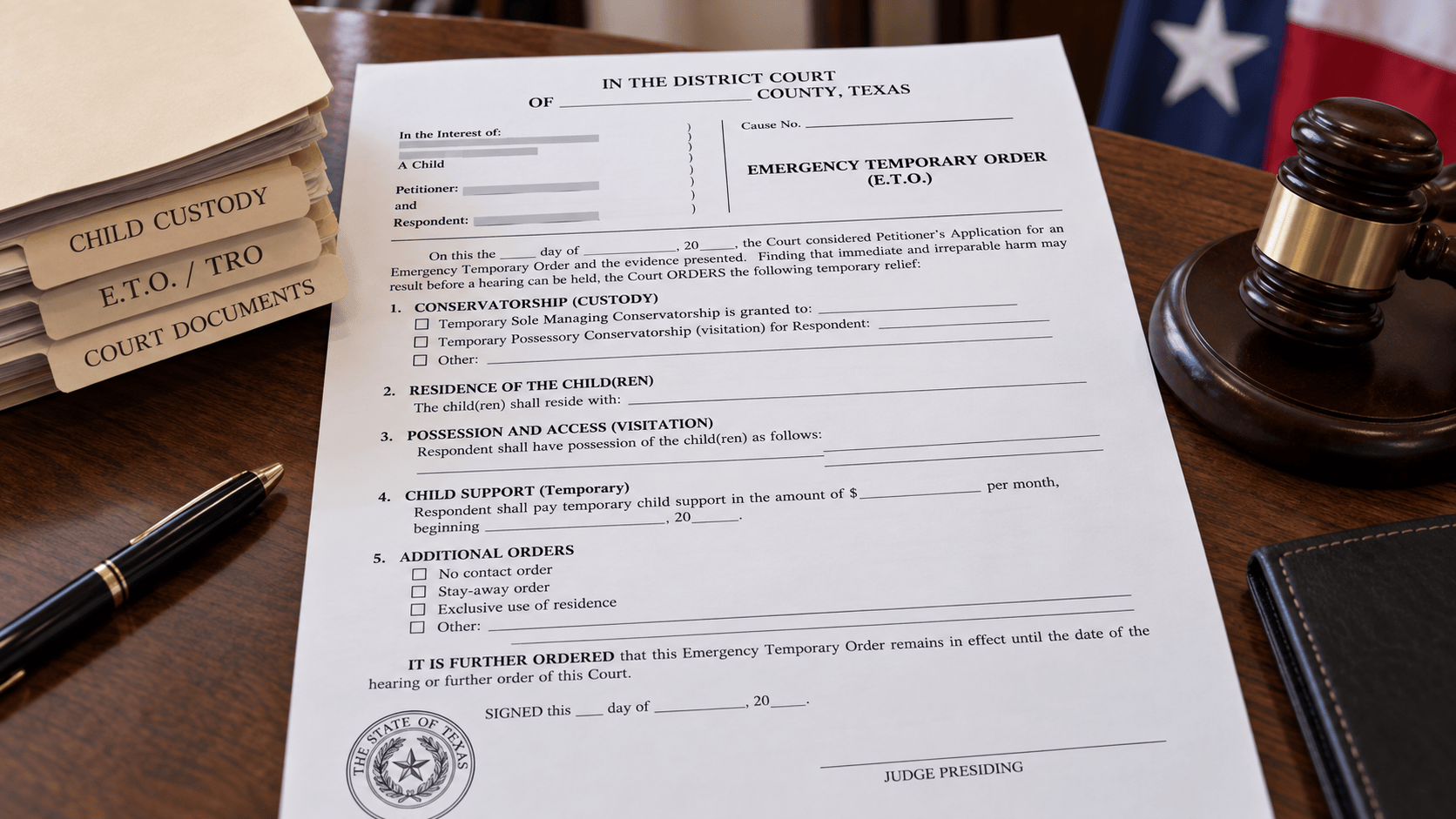
There are parents who seek an emergency temporary custody order in Texas because they fear that their child is in urgent danger.
Texas family courts have processes that may grant emergency temporary relief in appropriate cases.
One option might be to seek a Temporary Restraining Order, commonly known as a TRO.
A TRO is not the same as regular temporary orders.
According to TexasLawHelp, a TRO (Temporary Restraining Order) is an emergency order to prevent a person from doing something harmful until the court can hold a hearing. It says a Texas family-law TRO generally runs for 14 days or until the temporary orders hearing, whichever is sooner.
Generally, to obtain a TRO, the party must show specific facts justifying the need for immediate relief.
A TRO should not be viewed as a surefire way to get permanent custody.
Generally the aim is to keep things secure as they are until the court can hear from both parties.
And a family-law TRO is not the same as a family violence protective order. Protective orders are different laws and different procedures.
If you fear your child is in urgent danger, speak with an attorney immediately regarding legal remedies suitable to your particular situation.
7. Temporary Custody in a Modification Case
A widespread misperception is that interim custody orders are always modifiable if a parent requests a custody adjustment.
Texas law imposes substantial limitations on particular temporary alterations.
For example, Texas Family Code Section 156.006 limits when the court can enter temporary orders altering the person with the sole authority to identify the principal residence of a child or certain geographic restrictions contained in an existing final order.
One possibly relevant scenario is if the child’s present circumstances might seriously damage the child’s physical health or emotional development.
That can be quite different from merely arguing:
- “I think my house is better.”
- My child wants to come and live with me.
- “I and the other parent don’t agree.”
- ‘I have more time with the kid now.
If you want to temporarily alter primary custody in a modification proceeding, consult with a Texas family law attorney about the statutory requirements before you file.
8. Duration of Temporary Orders
The effective period of temporary orders is normally until:
- Replaced by final orders,
- Modified by the court or
- Otherwise denied by the court.
TexasLawHelp states that temporary orders remain in place until the final order is signed or the temporary orders are amended, as long as the case is pending.
This means a “temporary” custody agreement could remain in place for a substantial duration if the lawsuit takes months to conclude.
That’s one reason that you have to take a temporary orders hearing seriously.
Temporary orders are not necessarily the same as final orders, but occasionally the temporary period can affect the later litigation.
For instance, if each parent obeyed the order and the temporary schedule proved to be a stable environment for the child, evidence can be introduced at the court as to how the child fared under the temporary arrangement.
9. Mistakes to Avoid When Getting a Temporary Custody Order in Texas
Leveling Charges With No Backing
Whenever feasible, serious allegations should be substantiated by credible facts and proof.
Exaggerating conditions can damage your credibility.
The child as the bearer of the message
Don’t get a child to convey messages, gather evidence, or become involved in parental disagreements.
Just assume that anything you put on the internet could be exposed to the other lawyer or the judge at some point.
Disregarding Existing Court Orders
Follow the present order until it is lawfully amended, unless your counsel advises that some other legal remedy is available.
Sending Angry Messages
Text messages sent during a heated disagreement might be used as evidence.
Keep written communication child-centered and free of threats, insults, and unneeded confrontation.
Arriving Ill-Prepared
Hearings on temporary orders may occur rather early in litigation.
Don’t think “temporary” implies unimportant.
Before you go to court, prepare your documentation, witnesses, timeframe, and recommended parenting arrangement.
10. Frequently Asked Questions
1. How to Obtain a Temporary Custody Order in Texas?
Usually you will need to have a proper family law case opened and get temporary orders from the court. A hearing on temporary orders is often scheduled so each parent can present evidence and arguments.
The exact documents and process will depend upon the underlying case being a divorce, original SAPCR, modification or some other type of family law action.
Having an experienced family law attorney on your side will help to ensure the right motion is filed and that your evidence is properly prepared.
2. Can I Get Emergency Temporary Custody Without The Other Parent?
While Texas law may provide for emergency remedies before a full hearing, if appropriate, the granting of emergency relief is subject to legal standards and procedural limits.
A TRO can prevent some behavior until a hearing can be held, but a TRO is not a final custody order in its entirety.
Courts usually give the other side a chance to be heard shortly after the emergency relief has been granted.
3. Does temporary custody always become permanent custody?
No, Temporary orders are not final orders. The judge might adjust the temporary custody arrangement until the case is over. And a final order resolves the case. And a final order makes a final custody finding.
But the temporary arrangement might last for months and it’s important to be mindful of the temporary stage.
4. Can a Temporary Custody Order Be Modified?
Perhaps. TexasLawHelp explains that the judge might amend the temporary orders while the case is underway.
The propriety of the desired adjustment depends on the facts, procedural posture, current orders, and applicable Texas law.
“Don’t just cease to follow a temporary command because the circumstances have changed. If you need to change it, then go to court and get a legal change.
5. Can a Grandparent or Other Nonparent Get Temporary Custody in Texas?
Custody issues with nonparents have different rules than a regular two-parent custody battle.
Texas offers a variety of appropriate legal options for situations in which a non-parent needs temporary authorization to care for a child.
For example, Texas Family Code Chapter 34 has permission agreements, which allow a parent to give certain nonparents permission to care for a child and make decisions for him or her. TexasLawHelp says this kind of authorization might let a caregiver make important decisions without having to get a custody order.
Texas Family Code Chapter 35 also provides a process for some qualifying caregivers to petition the court for temporary authorization to care for a kid. TexasLawHelp notes a Chapter 35 temporary permission order is not custody and does not override the rights of a parent, conservator or guardian.
Additional standing and legal criteria may apply if a grandparent, relative, stepparent, or other nonparent wants actual conservatorship rather than interim caring authority.
11. Temporary Custody Order Texas: The Importance of Early Legal Advice
Temporary custody battles can move fast. Unlike many other legal situations, parents rarely have the luxury of time to compile years of information about their children, formulate a suggested parenting arrangement, locate witnesses, and prepare evidence before appearing in court.
What happens in the temporary orders phase can affect:
- Your child’s residence
- The frequency of your child’s
- Who makes the critical decisions?
- Child Support Responsibilities.
- Medical assistance
- School arrangements.
- Transportation
- Communication with Parents
This is why early preparation might be crucial.
A seasoned family law attorney in Texas can evaluate your situation, identify what form of relief might be available to you, tell you what the court will be looking for, and advocate your case.
12. Getting Ready for Your Temporary Custody Consultation
Before you see an attorney, you might want to collect:
- Current custody orders
- Divorce or SAPCR paperwork
- A chronology of noteworthy events
- Related text messages and email
- School records.
- Medical records
- Police reports or incident reports
- Photographic images
- planned schedule of possession
- Information on your child’s daily routine
- names of possible witnesses
- Evidence of major safety problems
- Proof of your participation in the life of the child
You should also state specifically what temporary orders you desire.
For example, instead of announcing, “I want custody,” talk about what has to be worked out.
Do you want the child to reside with you most of the time?
What visitation schedule do you want with the other parent?
Who makes the educational decisions?
What about the hospital bills?
Where should the exchanges happen?
Are there any safety restrictions?
Specific goals help your attorney to better analyze your position.
13. The Bottom Line About Temporary Custody Orders in Texas
In Texas, you can’t just ask a judge to give you interim possession of your child, because you think the child should be with you.
You need a good pending family court case, a legitimate request for temporary orders, proper preparation, and compelling proof of why your proposed arrangement best ensures the safety, welfare, and best interests of the kid.
Temporary orders might be made throughout the pendency of the case deciding conservatorship, primary residence, possession and access, child support, health insurance, and other critical parenting problems.
Emergency circumstances may merit greater relief, including a temporary restraining order, whereas modification cases can include heightened statutory standards before certain existing custody arrangements may be temporarily amended.
Each family is unique. What is the best thing to do will depend on your court orders, what is happening with your child, what kind of action is being brought, and what evidence you have.
14. How the Tess House Law Firm Can Assist
When your relationship with your child is at issue, you shouldn’t have to face a complicated Texas custody battle by yourself.
At the Tess House Law Firm, we help parents understand their options, prepare for temporary orders hearings, gather essential evidence, and pursue custody arrangements designed to safeguard the best interests of their children.

If you are starting a divorce, establishing custody for the first time, responding to another parent’s request for temporary orders, seeking a custody modification or facing an emergency involving your child’s safety, getting legal advice early can make a big difference.
Don’t wait until your temporary orders hearing is imminent to begin preparing.
Contact Tess House Law today to schedule a consultation,
Your rights, and what to do next to safeguard your child and your relationship as a parent.