
If you are thinking about adoption, one of the biggest choices you will face is whether to pursue an open or closed adoption. It is important to understand the differences, since each option affects the child, birth family, and adoptive family in unique ways. This guide will walk you through the key differences, benefits, challenges, legal issues, and important factors to help you make the best decision for your situation.
Table of Contents:
- What Is Adoption?
- What Is Open Adoption?
- Types of Open Adoption
- What Is Closed Adoption?
- Why Some Families Choose Closed Adoption?
- Open Adoption vs. Closed Adoption: Key Differences
- Benefits of Open Adoption
- Challenges of Open Adoption
- Benefits of Closed Adoption
- Challenges of Closed Adoption
- How Open and Closed Adoption Affect the Child?
- Legal Considerations
- Choosing the Right Adoption Plan
- Myths About Open Adoption
- Frequently Asked Questions
- Final Thoughts
- Contact Tess House Law Firm
What Is Adoption?
Adoption is a legal process that permanently establishes a parent-child relationship between a child and adoptive parents, transferring all parental rights and responsibilities from the child’s biological or birth parents to the adoptive family. Once an adoption is finalized by a court, the adoptive parents become the child’s legal parents in every sense of the law. They assume full responsibility for the child’s care, upbringing, education, healthcare, financial support, and overall well-being, while the legal rights of the birth parents are terminated unless otherwise provided by law.
Adoption has long provided children with safe, stable, and loving homes when they cannot remain with their biological families. Whether the adoption involves a newborn, an older child, a stepchild, or a relative, its primary purpose is always to serve the child’s best interests by providing permanence, security, and a supportive family environment.
Adoption has changed a lot in recent decades. In the past, most adoptions were kept very private, with sealed birth records to protect everyone’s privacy. Now, families have more options and can choose what works best for their needs and values. This change recognizes that every adoption is different, and sometimes keeping some contact between birth and adoptive families can help the child.
There are several types of adoption recognized throughout the United States, including:
- Domestic infant adoption, where a child born in the United States is adopted shortly after birth.
- International adoption, involving the adoption of a child from another country.
- Foster care adoption, in which children in the child welfare system are adopted after parental rights have been legally terminated.
- Stepparent adoption, allowing a stepparent to become the child’s legal parent.
- Relative or kinship adoption, where grandparents, aunts, uncles, or other family members adopt a child.
- Private agency or independent adoption, facilitated through licensed adoption agencies or adoption attorneys.
No matter which type of adoption you choose, you will also need to decide how much contact there will be between the birth family and the adoptive family after the adoption is complete. This is one of the most important choices in the adoption process: deciding between open and closed adoption.
As adoption practices change, the choice between open and closed adoption has become more important. In the past, most adoptions were closed, but today many families choose some level of openness and communication. In open adoption, birth and adoptive parents stay in touch after placement. In closed adoption, there is usually little or no contact after the adoption is finalized.
It is important to understand the differences between open and closed adoption because this choice affects everyone involved, especially the child. The degree of openness can affect a child’s sense of identity, access to medical history, emotional development, and understanding of their adoption story. It also affects the feelings of birth parents and the experience of adoptive families.
There is no single right answer when choosing between open and closed adoption. Every family’s situation is different, and what works for one may not work for another. Things like the child’s needs, the wishes of the birth parents, privacy, family relationships, safety, and state laws all matter when deciding what is best.
When families learn about each adoption option, they can make choices that put the child’s well-being first and respect everyone’s rights and expectations. This guide will explain the main differences between open and closed adoption, look at their benefits and challenges, and cover key legal points to help you feel confident as you move through the adoption process.
What Is Open Adoption?
Open adoption means that birth parents and adoptive parents keep in touch in some way after the adoption is complete.
How much they communicate depends on what everyone agrees to.
It may include:
- Phone calls
- Emails
- Text messages
- Video chats
- Letters
- Photos
- Scheduled visits
- Birthday celebrations
- Holiday gatherings
Some families remain extremely close, while others exchange only annual updates.
Open adoption is based on honesty and respect between families.
The adoptive parents are the child’s legal parents, but the birth parents keep the relationship they agreed on with the child.
Types of Open Adoption
Fully Open Adoption
Birth parents and adoptive parents know each other’s identities. Communication is direct and ongoing. Families often celebrate milestones together.
Semi-Open Adoption
Communication happens through an adoption agency or attorney. Names or addresses may remain confidential. Updates usually include photographs and letters.
Mediated Open Adoption
An adoption professional manages communication between both parties. This approach provides privacy while allowing meaningful contact.
What Is Closed Adoption?
In a closed adoption, also called confidential or traditional adoption, the birth parents’ and adoptive parents’ identities are kept private. There is little or no contact between them after the adoption is finished. Usually, the legal and personal connection between the birth family and the child ends once the adoption is complete.
In open adoption, families may keep in touch through letters, calls, emails, or visits. In closed adoption, the goal is to keep everyone’s identity private. Usually, adoptive families do not get identifying details about the birth parents, and birth parents do not get information about the adoptive family unless the law or both sides allow it.
Once a closed adoption is finalized by the court, the adoptive parents become the child’s legal parents and take on all rights and responsibilities. The birth parents’ legal rights end, and they no longer make decisions about the child’s life, education, or health.

Typically, in a closed adoption:
- Birth parents do not have ongoing contact with the child after placement.
- Adoptive parents receive only limited non-identifying information about the birth family, such as medical history, ethnic background, educational information, or general family characteristics.
- The child usually does not know the identity of their birth parents during childhood unless state law or later circumstances allow access to adoption records.
- Birth certificates and adoption records are often sealed in accordance with state law, limiting public access to identifying information.
- Communication between the birth parents and adoptive family generally ends after the adoption is finalized, although agencies may sometimes facilitate the exchange of updated medical information if necessary.
The degree of confidentiality in a closed adoption can vary depending on the state where the adoption occurs and the policies of the adoption agency or attorney handling the case.
Some states allow adult adoptees to request access to their original birth certificates or adoption records once they reach a certain age, while others require a court order or the consent of the birth parents before records can be released.
Historically, closed adoption was the standard practice throughout much of the twentieth century. Adoption professionals believed that maintaining strict confidentiality would help everyone move forward with their lives. Birth parents were often encouraged to keep the adoption private, while adoptive parents were advised to raise the child as though they had been born into the family. In many cases, children were not even told they had been adopted until much later in life or sometimes not at all.
This approach reflected societal attitudes of the time, when issues such as unplanned pregnancy, infertility, and adoption carried greater social stigma. Confidentiality was viewed as a way to protect the privacy of both birth parents and adoptive families while minimizing emotional complications.
Over the past several decades, adoption practices have changed considerably. Research has shown that many children benefit from having access to information about their biological families, leading to a growing preference for open or semi-open adoption arrangements. As a result, closed adoptions have become less common than they once were.
Even though closed adoption is less common now, it is still an important option for some families. Every adoption is different, and for some people, keeping things private gives them emotional security, privacy, or protection from difficult situations.
In the end, the choice between open and closed adoption depends on what is best for the child, the birth parents, and the adoptive family. Closed adoption is not better or worse than open adoption it is just one of several options to help make sure the child’s needs come first.
Why Some Families Choose Closed Adoption?
Although many modern adoptions involve some level of communication, there are still many situations in which a closed adoption is the most appropriate and beneficial choice. Families may choose a confidential adoption for emotional, legal, personal, or safety-related reasons.
Understanding these reasons can help prospective adoptive parents and birth parents determine whether this type of adoption aligns with their unique circumstances.
Birth Parents May Desire Privacy and Emotional Closure
For some birth parents, maintaining confidentiality after placement is an important part of the healing process. Choosing adoption is often accompanied by complex emotions, including grief, sadness, and loss. Continuing communication may make it more difficult for some individuals to move forward with their lives.
A closed adoption allows birth parents to:
- Maintain their privacy.
- Begin the emotional healing process without ongoing reminders.
- Protect sensitive personal information.
- Avoid unwanted future contact.
- Focus on education, career, or family goals following the adoption.
For these individuals, confidentiality can provide a sense of closure and help them feel confident that they made a loving decision for their child’s future.
Adoptive Parents May Prefer Clear Family Boundaries
Some adoptive parents believe that establishing clear family boundaries helps create stability during the child’s early years. Without ongoing communication, they can focus on building relationships and developing family routines without coordinating visits or maintaining regular contact with the birth family.
This approach may provide:
- Greater privacy for the adoptive family.
- Reduced uncertainty regarding future communication.
- Clear parental roles and responsibilities.
- Simpler family dynamics.
- Fewer logistical challenges involving ongoing contact.
It is important to note, however, that even in a closed adoption, adoptive parents remain responsible for helping the child understand their adoption story in an honest and age-appropriate manner.
Safety Concerns May Require Complete Confidentiality
One of the most compelling reasons for choosing a closed adoption involves protecting the safety of the child and adoptive family. In certain circumstances, maintaining confidentiality is necessary to prevent future harm or unwanted contact.
Closed adoption may be recommended when there is a history of:
- Domestic violence.
- Physical or emotional abuse.
- Child neglect.
- Substance abuse or addiction.
- Criminal activity.
- Stalking or harassment.
- Gang involvement.
- Human trafficking concerns.
- Severe mental health conditions that may endanger the child.
In these situations, limiting identifying information can help safeguard everyone involved while providing the child with a secure and stable environment.
Protecting the Child’s Long-Term Well-Being
In some cases, adoption professionals determine that limiting contact is in the child’s best interests due to concerns about instability or ongoing conflict within the birth family. A closed adoption may reduce exposure to stressful or potentially harmful situations, allowing the child to grow up in a consistent and nurturing home.
Respecting the Wishes of Both Parties
Occasionally, both the birth parents and the adoptive parents mutually agree that maintaining privacy is the most appropriate arrangement. Their decision may be based on personal beliefs, cultural considerations, emotional readiness, or practical circumstances. Adoption professionals and attorneys can help ensure that these wishes are documented and carried out in accordance with applicable state laws.
Even though open adoption is more common now, closed adoption is still a legal and valuable choice for families who want privacy, security, and clear boundaries. When deciding between open and closed adoption, it is important to think about both the benefits of staying in touch and the real reasons why privacy might be better for the child’s safety and future.
Open Adoption vs. Closed Adoption: Key Differences
Understanding the distinction between open adoption vs closed adoption begins with comparing their core characteristics.
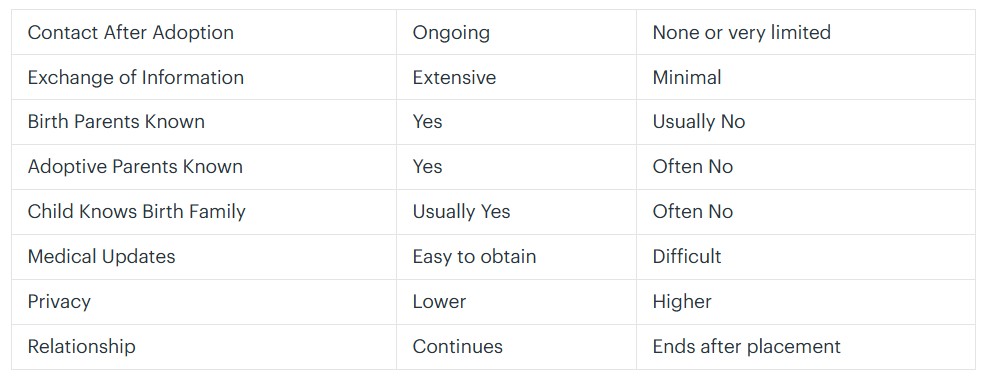
Neither option is universally better.
The best choice depends on the unique circumstances of everyone involved.
Benefits of Open Adoption
Many adoption professionals now encourage open adoption because it can offer emotional and practical benefits for everyone involved.
1. Better Identity Development
Children often wonder about their biological origins.
Knowing their birth family helps answer questions about:
- Heritage
- Culture
- Personality traits
- Medical history
- Family traditions
This knowledge often strengthens a child’s sense of identity.
2. Reduced Feelings of Loss
Birth parents frequently experience grief after placement. Ongoing contact can reassure them that their child is safe, healthy, and thriving.
3. Honest Communication
Open adoption removes secrecy. Children grow up understanding their adoption story from an early age. This often reduces confusion and resentment later in life.
4. Easier Access to Medical Information
Medical histories change over time.
Open communication allows adoptive families to receive updates about:
- Genetic disorders
- Chronic illnesses
- Mental health conditions
- Family medical history
This information can improve healthcare decisions.
5. Stronger Emotional Security
Children often feel reassured knowing they were placed out of love rather than abandonment.
Healthy relationships with birth parents can reinforce this understanding.
Challenges of Open Adoption
While open adoption has many advantages, it also requires commitment and healthy boundaries.
Emotional Complexity
Managing relationships between two families can be emotionally challenging. Everyone must communicate respectfully.
Changing Expectations
Needs evolve over time.
A communication plan that works during infancy may not suit a teenager.
Flexibility is essential.
Boundary Issues
Clear expectations should be established regarding:
- Visits
- Holidays
- Decision-making
- Social media
- Gifts
Healthy boundaries help prevent misunderstandings.
Geographic Distance
Long-distance relationships can make regular visits difficult.
Technology often helps bridge the gap.
Emotional Adjustment
Children may experience mixed emotions as they grow older.
Professional counseling may be beneficial during certain life stages.
Benefits of Closed Adoption
Although less common today, closed adoption continues to provide meaningful advantages in certain situations.
Greater Privacy
Some families prefer confidentiality. Birth parents may wish to move forward without ongoing contact.
Simplified Family Dynamics
With no continuing communication, adoptive parents can establish routines without coordinating visits.

Protection from Unsafe Situations
Closed adoption may be appropriate if there is:
- Domestic violence
- Abuse
- Criminal activity
- Substance addiction
- Serious mental health concerns
Protecting the child’s safety always comes first.
Emotional Closure
Some birth parents believe complete separation helps them heal emotionally.
Challenges of Closed Adoption
Closed adoption also presents unique challenges.
Limited Medical History
New genetic conditions cannot easily be shared.
Identity Questions
Children often become curious about:
- Birth parents
- Family history
- Ethnicity
- Cultural background
Without answers, they may struggle with identity.
Emotional Uncertainty
Many adoptees wonder why they were placed for adoption.
The lack of communication can lead to unanswered questions.
Difficult Reunions
As adults, adoptees sometimes seek biological relatives.
Reunions after decades apart may be emotionally complex.
How Open and Closed Adoption Affect the Child?
The child’s well-being should remain the central focus in any adoption decision.
Children in Open Adoption
Research suggests many children benefit from:
- Honest conversations
- Continued relationships
- Better understanding of their history
- Increased emotional security
Healthy communication often reduces feelings of rejection.
Children in Closed Adoption
Children in closed adoptions can also thrive in loving homes.
However, some may later experience curiosity regarding:
- Biological parents
- Siblings
- Family heritage
- Medical history
Supportive adoptive parents can help children navigate these questions.
Legal Considerations
Every state has different adoption laws.
Important legal considerations include:
Open Adoption Agreements
Some states recognize legally enforceable post-adoption contact agreements.
Others consider them voluntary.
Always consult an experienced adoption attorney.
Confidential Records
Closed adoption records are generally sealed. Access varies by state. Some adult adoptees may petition the court to obtain records.
Interstate Adoptions
Families adopting across state lines must comply with additional legal requirements. Professional legal guidance is highly recommended.
Choosing the Right Adoption Plan
Choosing between open adoption vs closed adoption requires careful evaluation.
Consider the following questions.
1. What Is Best for the Child?
Every decision should prioritize the child’s emotional, physical, and developmental well-being.
2. Are Both Families Comfortable with Communication?
Open adoption requires trust, honesty, and cooperation.
3. Are There Safety Concerns?
If safety is an issue, closed adoption may be more appropriate.
4. What Level of Privacy Is Desired?
Some families value ongoing relationships. Others prefer confidentiality.
5. Can Expectations Be Clearly Defined?
Written communication plans often prevent misunderstandings.
Myths About Open Adoption
Myth 1: Birth Parents Can Take the Child Back
False. Once adoption is finalized, adoptive parents have full legal parental rights.
Myth 2: Open Adoption Confuses Children
Research generally shows children understand family roles when adults communicate honestly.
Myth 3: Closed Adoption Prevents Curiosity
Children often remain curious about their biological origins regardless of the adoption type.
Myth 4: Open Adoption Means Co-Parenting
Birth parents do not share legal parenting authority.
Adoptive parents make all parenting decisions.
Myth 5: Closed Adoption Is Outdated
Although less common, closed adoption remains appropriate in many situations involving privacy or safety.
Frequently Asked Questions
1. Which is better: open adoption or closed adoption?
Neither option is universally better. The right choice depends on the needs of the child, birth parents, adoptive parents, and any safety or privacy concerns. The child’s best interests should always guide the decision.
2. Can an open adoption become closed later?
Yes. Communication arrangements can change over time if all parties agree or if circumstances require changes. In some cases, contact may decrease naturally as families’ needs evolve.
3. Are open adoption agreements legally enforceable?
It depends on state law. Some states recognize post-adoption contact agreements as legally enforceable, while others treat them as voluntary. An adoption attorney can explain the laws that apply to your situation.
4. Can adoptees access their original birth records in a closed adoption?
Access varies by state. Some states allow adult adoptees to request their original birth certificates or adoption records, while others require a court order or the consent of the birth parents.
5. How can an adoption attorney help with choosing between open and closed adoption?
An experienced adoption attorney can explain your legal rights, draft or review adoption agreements, ensure compliance with state laws, and guide you through every stage of the adoption process. Legal guidance helps protect everyone involved and supports a smoother adoption experience.
Final Thoughts
The conversation about open versus closed adoption is not about which option is always better. It is about finding the arrangement that best supports the child and respects the needs of both birth and adoptive families.
Open adoption gives families more openness, ongoing relationships, and easier access to family and medical history. Closed adoption offers more privacy and can be the best choice when safety or confidentiality is needed. Both options have their own benefits and challenges, and every adoption is unique.
If you are thinking about adoption, it is important to learn about your legal rights and responsibilities. Talking to an experienced adoption attorney can help you understand your options, comply with state laws, and develop a plan that puts the child’s well-being first.
Contact Tess House Law Firm
Deciding between open and closed adoption is a big step, and you do not have to do it alone. At Tess House Law Firm, our experienced adoption attorneys are here to offer caring and knowledgeable legal help that fits your family’s needs.

Whether you are an expectant parent, a prospective adoptive parent, or a relative looking for legal advice, our team is ready to protect your rights and help you move forward with confidence. We can explain your legal options, help with adoption agreements, ensure you comply with state laws, and always put the child’s best interests first.
Contact Tess House Law today to schedule a consultation. We are here to help you make informed choices, protect your family’s future, and guide you through the adoption process with trusted legal advice and personal support.